






 World Affairs Council of Charlotte China Town Hall Conversation on “The U.S.-China AI Race”

Min Jiang (Ph.D.)
Professor of Communication Studies, Affiliate Faculty of International Studies & Ph.D. Program in Public Policy at UNC Charlotte
In early March 2026, Beijing legislators approved China’s five-year plan (2026-2030), with a clear roadmap outlining its intention to become a global leader in artificial intelligence and to adopt emerging technologies such as humanoid robots and quantum computing.
The strategy is clear: China is hyper-focused on scaling its technological muscle and self-sufficiency by boosting funding for research and development, reducing bottlenecks that prevent it from developing key technologies like advanced semiconductor chips, and embedding AI across every layer of Chinese society.
Meanwhile, in July 2025, the current U.S. administration released an artificial intelligence strategy plan titled “Winning the AI Race,” which framed AI advancement as a competition with a single winner echoing the urgency of the Cold War space race. The message is clear: the country that achieves dominance in AI will gain an overwhelming economic, military, and geopolitical edge for decades to come.
As both nations push forward, the question becomes increasingly urgent. Are the world’s two leading powers on a collision course in the race for AI dominance? Dr. Min Jiang will help us understand the complex intersection between global politics, foreign policy, and the accelerating competition between China and the U.S., and what it means for international affairs and the future of technology worldwide.
Tuesday, April 7th, 2026
Presentation and Q&A:
5:30 – 6:30 p.m. ET / 2:30 – 3:30 p.m. PT
*The Zoom link will be provided to attendees upon confirmation of registration.


Biography
Dr. Min Jiang is a Professor of Communication Studies at UNC Charlotte, CyberBRICS Visiting Professor at FGV Law School (Rio, Brazil) and Non-resident Scholar at New America, a DC- based tech think tank. She is also a Secretariat member of the annual international Chinese Internet Research Conference, and Vice Chair of the Communication Law & Policy Division of the International Communication Association. Her scholarly work examines the intersections of digital technology, geopolitics, and policy with a focus on China and the Global South. She is lead editor of the book Digital Sovereignty in the BRICS Countries, published in 2024 by Cambridge University Press. She is also the lead editor of US-China Power Relations, a book currently under contract with Michigan State University Press. She has published more than 40 journal articles and book chapters and serves on the editorial boards of several flagship journals in Communication Studies. National and international media outlets including Reuters, Foreign Policy, Financial Times, The Chronicle of Higher Education, Australian Broadcasting Corporation among others have interviewed her about her work. She received her Ph.D. in Communication from Purdue University.
***********************************************************************************************************************
 2026 Annual China Town Hall Hosted by the National Committee on United States-China Relations
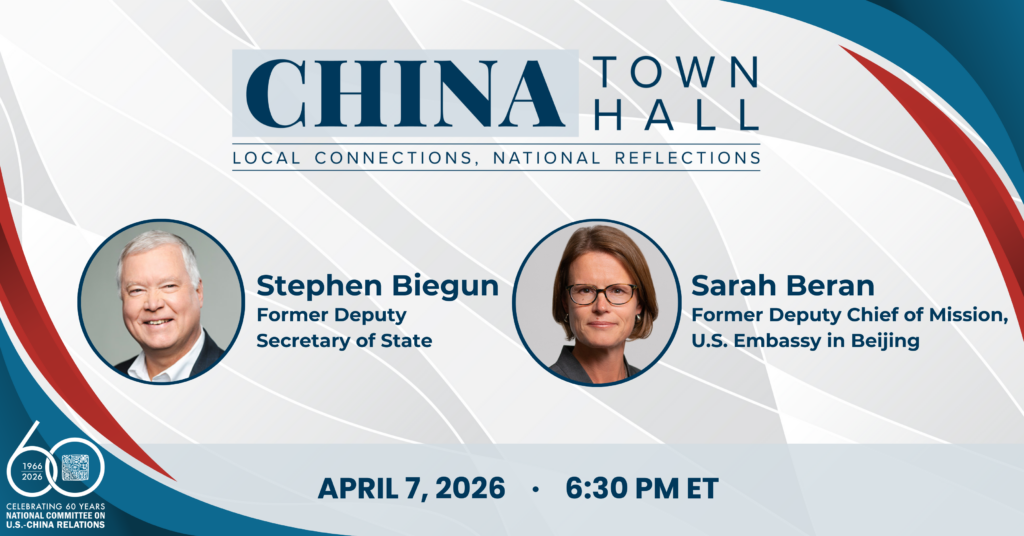
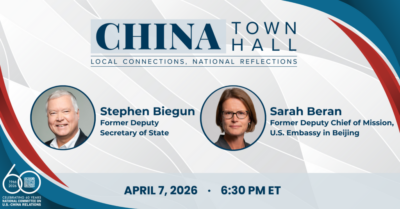
CHINA Town Hall (CTH), a program that provides a snapshot of the current U.S.-China relationship and examines how that relationship reverberates at the local level – in our towns, states, and nation – connects people around the country with U.S. policymakers and thought leaders on China.
The 2026 CHINA Town Hall program will take place Tuesday, April 7, at 6:30 p.m. ET/3:30 p.m. PT, with two veteran senior diplomats discussing the current state and future trajectory of the U.S.-China relationship: Stephen Biegun, former U.S. deputy secretary of state, and Sarah Beran, former deputy chief of mission at the U.S. Embassy in Beijing and former senior director for China and Taiwan affairs at the White House National Security Council.
Since CTH launched in 2007, the National Committee has proudly partnered with a range of institutions and civic groups, colleges and universities, trade and business associations, world affairs councils and think tanks to convene town halls and bring this important national conversation to local communities around America (and a few overseas).
Program Information:
Date:
Tuesday, April 7th, 2026
Presentation and Q&A:
6:30-7:30 p.m. ET / 3:30-4:30 p.m. PT
Biography:
Sarah Beran, Partner, Macro Advisory Partners; Former Deputy Chief of Mission, U.S. Embassy in Beijing
Sarah Beran is a partner at Macro Advisory Partners, joining the firm in 2025 following a distinguished career in the U.S. Foreign Service, most recently as deputy chief of mission at the U.S. Embassy in Beijing.
From 2022 to 2024, Ms. Beran served as senior director for China and Taiwan Affairs at the White House National Security Council. Her portfolio encompassed technology export controls, investment screening, trade policy, counternarcotics, Russia sanctions and Taiwan contingency planning. She led strategic preparations for multiple heads-of-state summits, negotiated the reopening of senior diplomatic channels with Beijing, and helped forge the first U.S.-China understanding on AI safety in the context of nuclear command and control.
Ms. Beran also served as then-U.S. Secretary of State Anthony Blinken’s deputy executive secretary for the Indo-Pacific, led the office responsible for U.S. engagement in APEC, and served as former U.S. Secretary of State Mike Pompeo’s director of the office of Chinese and Mongolian Affairs. She was posted overseas in Beijing, Islamabad, Jerusalem, and Quito. Her previous domestic assignments include office director for economic policy in the Bureau of East Asian and Pacific Affairs, special assistant to then-Secretary of State Condoleezza Rice, and Lebanon desk officer.
Ms. Beran speaks Mandarin and Spanish. She joined the Foreign Service in 2002 and graduated from Claremont McKenna College in 1999. She is a member of the National Committee on U.S.-China Relations.
Stephen Biegun, Former Deputy Secretary of State
Stephen Biegun has more than three decades of international affairs experience in government and the private sector, including high-level government service with the Department of State, the White House, and the United States Congress. In 2021, Mr. Biegun concluded his most recent government service as the Deputy Secretary of State, to which he was confirmed by the Senate with a strong bipartisan vote of 90-3. In addition to his government service, Mr. Biegun has also served as a corporate vice president with Ford Motor Company and The Boeing Company.
Mr. Biegun began his career as a foreign policy specialist with the United States Congress, with a focus on Russia, the former Soviet Union, and Europe, ultimately rising to a number of senior-level positions including chief of staff of the Senate Foreign Relations Committee and as the national security advisor to Senate Majority Leader. He spent two years as the Executive Secretary of the White House National Security Council, serving as an advisor and deputy to the National Security Advisor. In the early 1990s, Mr. Biegun led a Moscow-based technical assistance program working closely with Russia’s first post-Soviet government.
Mr. Biegun has volunteered as a board member for several international, national, and local non-profit organizations and currently serves on the boards of the National Endowment for Democracy and the German Marshall Fund. He graduated from the University of Michigan, Ann Arbor with a Bachelor of Arts degree in Russian language and political science.